
★TTCBF: A Truncated Taylor Control Barrier Function for High-Order Safety Constraints
arXiv preprint arXiv:2601.15196 · 2026
BibTeX
@article{xu2026ttcbf,
 archiveprefix = {arXiv},
 author = {Xu, Jianye and Alrifaee, Bassam},
 doi = {10.48550/arXiv.2601.15196},
 eprint = {2601.15196},
 journal = {arXiv preprint arXiv:2601.15196},
 primaryclass = {eess},
 publisher = {arXiv},
 title = {TTCBF: A Truncated Taylor Control Barrier Function for High-Order Safety Constraints},
 year = {2026}
}
Abstract
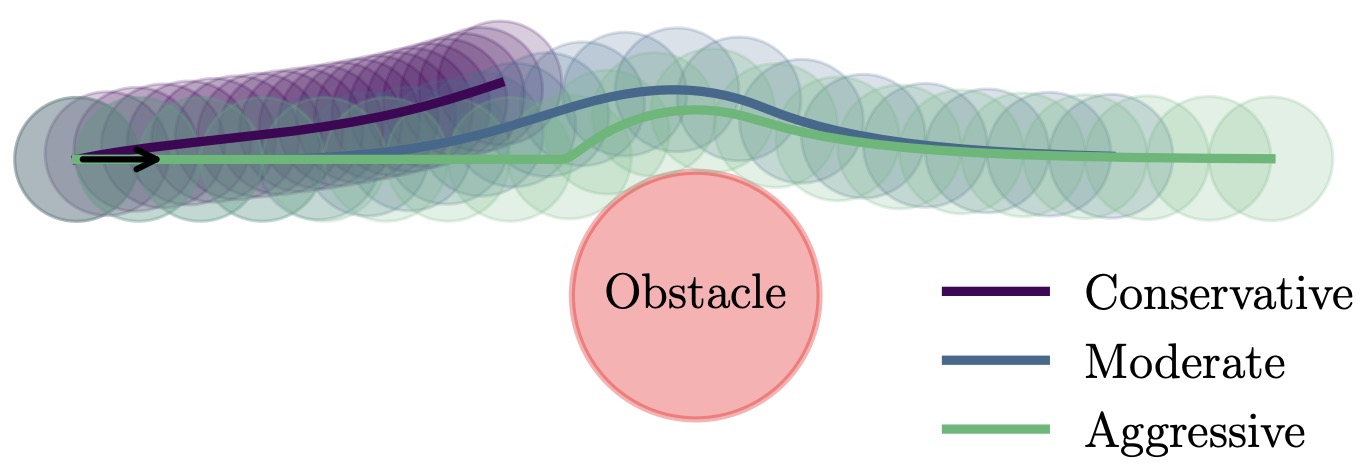
Control Barrier Functions (CBFs) enforce safety by rendering a prescribed safe set forward invariant. However, standard CBFs are limited to safety constraints with relative degree one, while High-Order CBF (HOCBF) methods address higher relative degree at the cost of introducing a chain of auxiliary functions and multiple class K functions whose tuning scales with the relative degree. In this paper, we introduce a Truncated Taylor Control Barrier Function (TTCBF), which generalizes standard discrete-time CBFs to consider high-order safety constraints and requires only one class K function, independent of the relative degree. We also propose an adaptive variant, adaptive TTCBF (aTTCBF), that optimizes an online gain on the class K function to improve adaptability, while requiring fewer control design parameters than existing adaptive HOCBF variants. Numerical experiments in a relative-degree-six spring-mass system and a cluttered corridor navigation validate the above theoretical findings.